Top Signs You Need Garage Door Service – Don’t Ignore These
A garage door that takes three seconds longer to open than it did six months ago has already lost a measurable amount of spring tension. The distance between “slow” and “snapped spring” is usually one more Connecticut winter. Most homeowners call us the day the door finally quits, when they could have called weeks earlier and paid for a small fix instead of a big one. Here’s how to read the warnings before they become an emergency. If you’d rather not climb around a moving door yourself, call (833) 679-1963 and we’ll take a look.
What follows treats each symptom as data. A garage door is a set of mechanical parts under load, and when one part wears it announces itself in a specific way. Learn the language and you can tell a tired roller from a failing spring before either one strands your car.
Why these signs matter more than they look
Garage doors fail in a sequence, not all at once. A worn part rarely breaks alone; it leans on its neighbors until the weakest one gives. That’s the part most people miss: the symptom you notice is often not the part that started the problem. In our experience at Garage Door Repair Meriden, a door that “suddenly” snapped a spring usually had a worn roller or a dry hinge telegraphing trouble for weeks. The cost gap between catching it early and catching it late is wide, so a five-minute monthly look pays for itself.
Key Takeaways
- Slow or jerky opening usually means spring tension is fading, not that the opener is weak.
- Each noise points to a specific part: grinding, squealing, popping, and rattling are four different conversations.
- A balanced door should hold itself open halfway; if it drops or rises on its own, the springs are the suspect.
- Frayed cable strands and rusty springs are visible before they fail. Look for them.
- Ignoring one worn part loads the next one, which turns a small repair into a larger one.
Slow, heavy, or jerky opening: the spring is talking
If the door opens slower than it used to, or hesitates near the top, the torsion or extension springs have likely lost tension. Springs do the lifting; the opener mostly guides. When a spring weakens, the opener works harder to drag the door up, and that strain transfers to the motor and the cables. A door that reverses partway or stops mid-travel is showing the same wear in a louder voice.
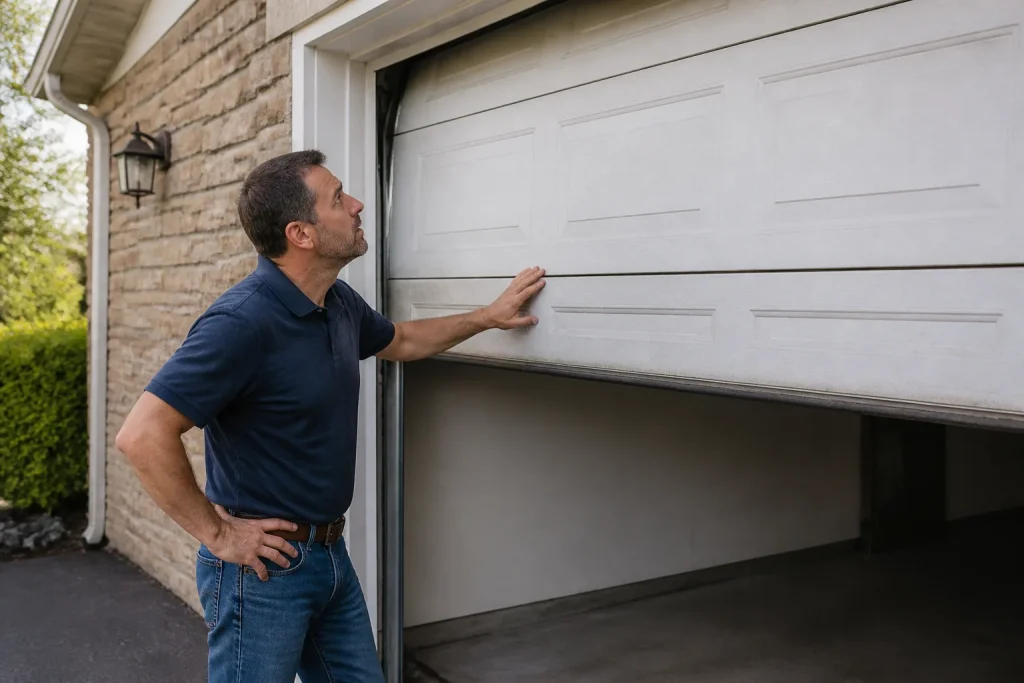
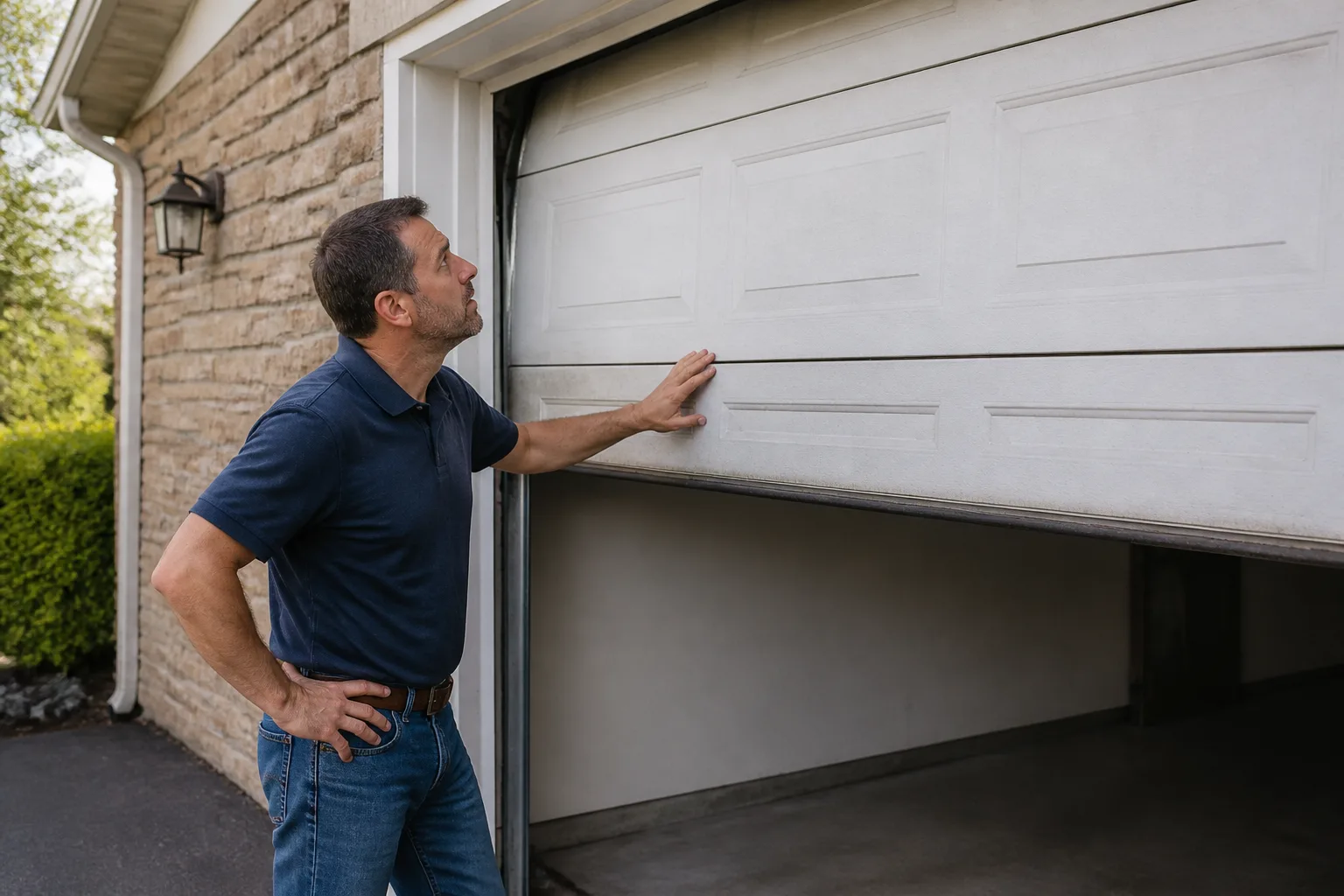
Here’s the balance test that confirms it. Close the door, pull the manual release cord to disconnect the opener, then lift the door by hand to about halfway and let go. A balanced door should stay put. If it sinks, the springs aren’t holding their share; if it shoots up, they’re wound too tight.
- Sags on its own: weak springs, the most common cause.
- Rises on its own: springs over-tensioned or the wrong size.
- Hard to lift by hand: binding rollers or a failing spring working against you.
Safety note: springs are the highest-tension parts on the whole system and can cause serious injury if handled without the right tools. Leave the winding and the replacement to a trained technician. For a deeper look at what that work involves, see our garage door spring repair.
The noise tells you which part is failing
Noise is diagnostic. The type of sound narrows down the guilty component faster than a visual inspection, which is why we ask homeowners to describe it before we arrive. If you’re in Meriden and your door has started a new soundtrack, listen closely:
- Grinding: metal-on-metal contact, often a roller that has seized and is dragging instead of rolling, or dry hinges scraping.
- Squealing: usually a dry or worn roller, or a torsion tube that needs lubrication at the bearing plates.
- Popping: a cable jumping its drum, or a spring that’s about to fail. This one deserves an immediate call.
- Rattling: loose hinges, brackets, or track bolts vibrating as the door travels.
A new noise that shows up and stays is never just “the door being old.” It’s a part telling you it’s past its service life. Catch it at the squeal stage and you’re replacing a roller; wait for the pop and you may be replacing a cable and a spring together.
Visible wear most homeowners walk right past
You don’t need to disassemble anything to spot the big three. A quick look from the floor catches them, and each one is concrete enough to self-diagnose.
- Frayed cable strands. Look at the cables running along each side. A healthy cable is smooth and tight; a failing one shows broken strands poking out like a worn rope. That’s a replace-now sign, not a wait-and-see.
- Rust patterns on the springs. Light surface rust is normal. Flaking, pitting, or rust concentrated on one coil means the metal is thinning and the spring is nearing the end of its life. Connecticut’s wet winters and road salt tracked onto the door accelerate this.
- Roller flat spots. Run the door up and look at the rollers. A roller with a flat side, a crack, or visible wobble has stopped rolling smoothly and is now skidding in the track.
None of these require tools to find, just a flashlight and two minutes. If you spot two or more, the door is due for service regardless of how it feels day to day.
Opener symptoms: when the motor is the problem
Sometimes the door is fine and the opener is the one complaining. A remote that only works up close, a motor that hums without moving the door, or lights that flicker when you press the button all point to the opener rather than the door hardware. Smart openers in the LiftMaster and Chamberlain/MyQ family can also throw error codes that tell you exactly what’s wrong if you know where to look. Older Craftsman and Genie units tend to show their age through weak travel limits and sluggish response.
One quick check before you assume the worst: if the door moves fine by hand but not from the opener, the issue is in the motor, the drive, or the safety sensors, not the springs. That distinction saves a lot of guesswork. For brand-specific troubleshooting, our garage door opener repair covers the smart and legacy systems most Meriden homes actually have.
The compounding failure risk: why small turns big
This is the part worth reading twice. A worn roller doesn’t just make noise. It stops rolling and starts dragging, which adds load to the cable pulling that side of the door. The extra load stresses the cable drum, and the drum passes the strain up to the springs and the opener motor. One cheap part quietly taxes the whole chain. What starts as an $80 roller swap can snowball into a cable, drum, and opener job if it’s left alone long enough. We’re not saying that to scare you; it’s just how the mechanics stack. The earlier in that chain you jump in, the smaller the bill.
When to call a pro
Some things you can safely handle: wiping down the tracks, tightening a loose bracket, and keeping the door’s moving parts lubricated. But anything involving springs, cables, or the torsion assembly is a call-it-in job, and so is a door that’s come off its track or won’t close at all. Those are the moments our garage door repair service exists for, and we offer emergency service for the door that won’t shut at night or won’t open before work.
Related services in Meriden
Watching for these signs and want a professional read on what you’re seeing? Start with Garage Door Repair Meriden for the full picture, or jump straight to the specific fix. We work on every major brand, including Wayne Dalton and Raynor, so the part you need is the part we know.
The Bottom Line
These warning signs aren’t random bad luck; each one points to a specific part that’s past its service life, and the window to act is measured in weeks. Slow opening means fading springs. A new grinding or popping noise names the failing component. Frayed cables and rusty springs are visible before they break. And every ignored symptom adds load to the next part in line. The smart move is to catch the small one early. If you’re in Meriden and want a straight answer about what your door is telling you, Garage Door Repair Meriden offers free estimates and quotes the price in writing before any work begins. Our technicians have up to 12 years of experience and treat the door as a system, not a one-off fix. Call (833) 679-1963 for a free estimate.
Frequently Asked Questions
A door that opens slowly, feels heavy when you lift it by hand, or won’t hold itself open halfway usually has weak springs. Rust on the coils and a door that reverses partway are further signs. Springs are under high tension, so don’t test or replace them yourself. Call (833) 679-1963 for a free estimate.
Grinding usually means metal-on-metal contact, most often a seized roller dragging in the track or a dry hinge. It’s a part telling you it’s worn out. Left alone, that drag adds load to the cables and opener. Call (833) 679-1963 and we’ll diagnose it.
No. A frayed cable is holding tension that can release suddenly, and it can cause serious injury. Broken strands poking out of the cable mean it needs replacing now by a trained technician. Call (833) 679-1963 for a free estimate.
Weeks, not months, for most mechanical wear. A small fix like a roller or a hinge is quick, but ignoring it lets the load pile onto the cable, drum, and opener. Catching the first symptom early keeps the repair small. Call (833) 679-1963 to get ahead of it.
Written by the team at Garage Door Repair Meriden.
Need Garage Door Help?
Call Garage Door Repair Meriden - the local pro we connect you with is licensed and insured, here with fast after-hours help in Meriden.
(833) 679-1963